
Dr. Tanveer Ahmad and Hafsah Tihami
Pakistan, particularly its eastern part is suffering from locust outbreak since June 2019. The KPK government, in January 2020, announced a provincial emergency in 9 southern districts for locust outbreak control. Further, a national emergency was declared by the GoP on 1st February 2020, to protect crops and help farmers. The current locust outbreak began with heavy rainfalls in 2018 in the Rub’ al Khali of the Arabian Peninsula. The swarms spread from there areas to Iran, Pakistan, India and south to east Africa. At present 23 countries in the world are facing locust outbreak across the Middle East, South Asia, and East Africa.
The available data indicates that locust swarms can fly up to 90 miles per day. The locust number can be increased up to 20 folds in 3 months under rainfall and other favorable conditions. The present locust activity is posing a heavy damage to crops, causing threats to food security in the coming months. They have jeopardized harvests in agricultural heartlands in Pakistan. Millions of people are set to face food shortage as desert locust swarms are embarked on the crops of the continent. According to FAO, a small swarm can eat as much food to feed 35,000 people/day. UN estimates that a locust swarm containing 40-80 million insects can utilize the same amount of food a day as of 3 million people.
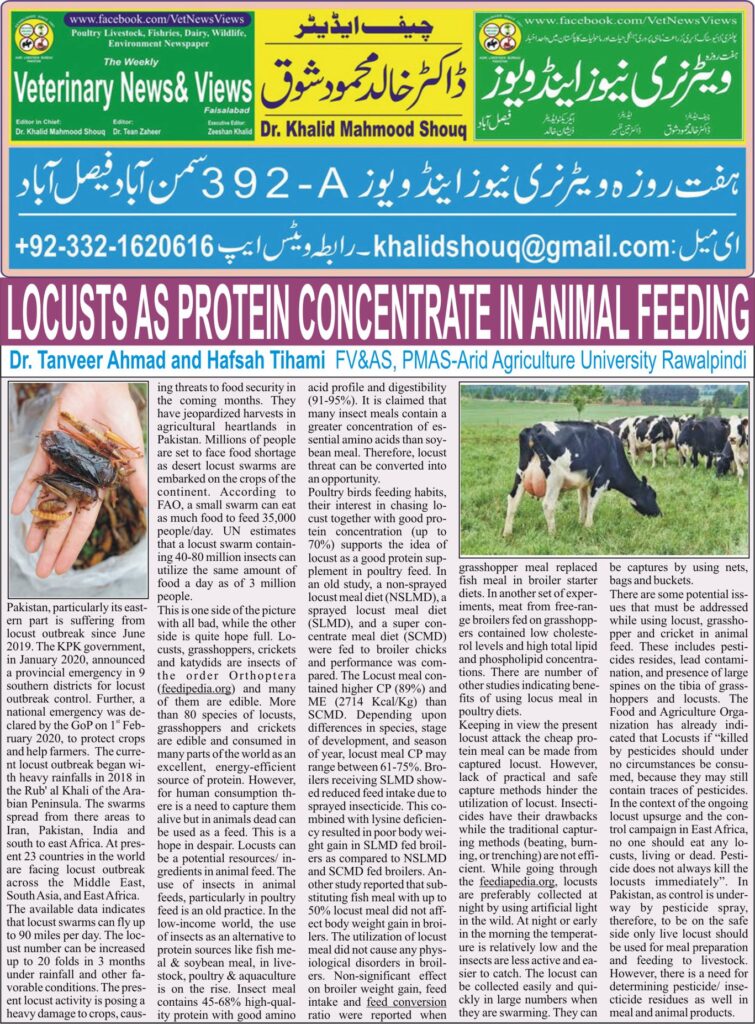
This is one side of the picture with all bad, while the other side is quite hope full. Locusts, grasshoppers, crickets and katydids are insects of the order Orthoptera (feedipedia.org) and many of them are edible. More than 80 species of locusts, grasshoppers and crickets are edible and consumed in many parts of the world as an excellent, energy-efficient source of protein. However, for human consumption there is a need to capture them alive but in animals dead can be used as a feed. This is a hope in despair. Locusts can be a potential resources/ingredients in animal feed. The use of insects in animal feeds, particularly in poultry feed is an old practice. In the low-income world, the use of insects as an alternative to protein sources like fish meal & soybean meal, in livestock, poultry & aquaculture is on the rise. Insect meal contains 45-68% high-quality protein with good amino acid profile and digestibility (91-95%). It is claimed that many insect meals contain a greater concentration of essential amino acids than soybean meal. Therefore, locust threat can be converted into an opportunity.
Poultry birds feeding habits, their interest in chasing locust together with good protein concentration (up to 70%) supports the idea of locust as a good protein supplement in poultry feed. In an old study, a non-sprayed locust meal diet (NSLMD), a sprayed locust meal diet (SLMD), and a super concentrate meal diet (SCMD) were fed to broiler chicks and performance was compared. The Locust meal contained higher CP (89%) and ME (2714 Kcal/Kg) than SCMD. Depending upon differences in species, stage of development, and season of year, locust meal CP may range between 61-75%. Broilers receiving SLMD showed reduced feed intake due to sprayed insecticide. This combined with lysine deficiency resulted in poor body weight gain in SLMD fed broilers as compared to NSLMD and SCMD fed broilers. Another study reported that substituting fish meal with up to 50% locust meal did not affect body weight gain in broilers. The utilization of locust meal did not cause any physiological disorders in broilers. Non-significant effect on broiler weight gain, feed intake and feed conversion ratio were reported when grasshopper meal replaced fish meal in broiler starter diets. In another set of experiments, meat from free-range broilers fed on grasshoppers contained low cholesterol levels and high total lipid and phospholipid concentrations. There are number of other studies indicating benefits of using locus meal in poultry diets.
Keeping in view the present locust attack the cheap protein meal can be made from captured locust. However, lack of practical and safe capture methods hinder the utilization of locust. Insecticides have their drawbacks while the traditional capturing methods (beating, burning, or trenching) are not efficient. While going through the feediapedia.org, locusts are preferably collected at night by using artificial light in the wild. At night or early in the morning the temperature is relatively low and the insects are less active and easier to catch. The locust can be collected easily and quickly in large numbers when they are swarming. They can be captures by using nets, bags and buckets.
There are some potential issues that must be addressed while using locust, grasshopper and cricket in animal feed. These includes pesticides resides, lead contamination, and presence of large spines on the tibia of grasshoppers and locusts. The Food and Agriculture Organization has already indicated that Locusts if “killed by pesticides should under no circumstances be consumed, because they may still contain traces of pesticides. In the context of the ongoing locust upsurge and the control campaign in East Africa, no one should eat any locusts, living or dead. Pesticide does not always kill the locusts immediately”. In Pakistan, as control is underway by pesticide spray, therefore, to be on the safe side only live locust should be used for meal preparation and feeding to livestock. However, there is a need for determining pesticide/insecticide residues as well in meal and animal products.
In short, making locust protein meal, with all precautions, not only helps to reduce the locusts jeopardizing the crops, but also enhances economical livestock and poultry feed production.
FV&AS, PMAS-Arid Agriculture University Rawalpindi