
It is the care and management of baby chicks, until they do not require any type of artificial heat. It ranges from 4-6 weeks. The types of brooding systems are;
Colony brooding: It is the brooding in small groups.


·. Continuous Brooding: Here a large number of chicks are brood together.
Pre-Brooding Requirements
There should be proper isolation of brooding house farm other houses. There should be all in all-out system.
Cleaning of brooding house and equipments:
Before brooding, the house should be cleaned, disinfected and ready to brood. There should be 2 weeks of rest period of house between successive broodings. Disinfection and fumigation will kill the most disease organisms and empty house will break the life cycle of most of there remaining.
Procedure:
1. Clean all litter, manure, direct and old feed from floor.
2. Thoroughly wash and disinfect all house and equipments.
3. Flush outs and disinfects all water lines.
4. Place all the equipment in their proper position prior to fumigation.
5. Seal and air tight the room, bring temperature 70°F and max humidity. Fumigate and real the house for 24h. Now air the house for 48h.
6. Check all preparation then start the brooder 24h before chick arrival.
Requirements at the time of chick arrival:
i-A man should wear clean and hygienic boots and clothe.
ii-The surrounding temperature should not exceed to25°C when chicks are in boxes.
iii-Take out the chicks from the boxes by rolling.
iv-The litter should be cover with paper and the depth of litter should be 2″.
v-The water should be filled with clean water.
vi-Sprinkle crack maize on paper.
vii-Provide 24h light for first 3 days.
Brooding Requirements:
Brooder: It is a heat-supplying source.
Brooder Guard: During Ist few days (12-14) a guard of card board, wood or metal from15-18″ height should be placed around the hover at the distance of 2-3 feet to keep the chicks near the heat source and to save them from draft/cold air. Mesh wire guard is recommended in summer.
Brooder Capacity: There should be 500 egg type chicks or 350 broiler chicks per and brooder.
Brooder Temperature: On an are the range of temperature at 6″ outside the canopy and 2″ above the temperature of litter should be 95°F. Then decrease 5°F per week until 75°C. Thermometers are poor indictor of requiring temperature but the distribution of chicks in the area indicate the required temperature.
Ventilation: Constant ventilation is required to remove NH3, CO2 and especially moisture because chick feces contain 75-80% moisture about 0.1 ft3 of air per bird/minutes required.
Humidity: It is the %age of moisture. there will be more growth of microorganisms and litter become wet, which result in coccidiosis and respiratory problems. If humidity is less there will be problem of dusty litter and respiratory infection.
Water: Chicks must learn quickly to eat and drink, although, they can survive up to 3 days, but it will be detrimental. Any delay can result in dehydration and weakens the bird. Provide good quality H2O for 24hr. Add sucrose about ½ kg/gallon water to avoid pasting. If birds are in stress use water-soluble vita. and electrolytes for first 3 days. Provide water 3h before feeding to avoid dehydration and pasting.
Feed: As a Ist feed provide 100% cracked maize on the paper. Next day provide 75% maize and 25% usual feed and soon. It should be provide on large flat containers to makes sure that all chicks must eat, there should be enough feeders and plenty of light. Keep the brooder heat high enough so chicks don’t away from feed place the feederlid out side the covered area of canopy to provide better light. Feed the cracked corn for only 2 days at the rate of 1lb/100 chicks.
Water space: One-chick waterer/100 chicks or 2 fount/100.
Feed space: One-container/100 chicks. Supply one feederer for 100 chicks. Give the Ist feed 3h after the chick arriver, sprinkling it over entire area of the feeder lid. To make sure that all chicks must eat there should be enough feeders and plenty of light. Keep the brooders heat high enough chicks don’t away from feed. Place the feeder lid out side the covered area of canopy to provide better light. Feed the cracked corn for only 2 days at the rate of 10 lb/1000 chicks (free of fungus).
Floor Space Requirements:
During brooding floor space requirement is as fellows.
I. Broiler 0.5ft2
II. Leghorn 0.75ft2
III. Leghorn breeder pullets 0.85ft2
IV. Leghorn breeder cockerels 1ft2
V. Meat type breeder pullets 1ft2
VI. Meat type breeder cockerels 1.25ft2
Sanitation: It includes.
1) Removing of droppings. It should be done after 2-3 weeks in summer. In winter clean, when dropping are not frozen. Scatter on absorbent e.g., superphosphate or use new litter over dropping. Frequent moving of feeders and waterers will help to clean the ground where germs have collected.
2) Renewing of litter. A good ventilation system near the water vessels and proper floor space will aid in keeping litter dr. As long as litter is dry, it may be felt on floor at least during winter. Keep the litter stir; otherwise it may be lumpy and wet.
3) Clean and disinfect the house at least once a year.
4) Remove and dispose of sick and dead birds, feathers and dressing waste.
Sunlight: It is nature’s way of killing disease producing organisms. Troughs and other equipments should be clean and exposed to sunlight periodically. Houses should be constructed so that sunlight can be let in during cold weather. It also helps in formation of vita. D. and quickens the body activities of a bird.
Different Practices:
I. Flushing: At first after receiving chick flushing is done. For this use 250gm sugar/gallon H2O. It provides energy and clears the digestive tract. Some times vent pasting occurs and flushing is again needed. In sever case use MgSO4 ½ teaspoon in one gallon of water.
II. Ground Maize: Ground maize should be provided for 2-3 days as a major part of feed. It is a good source of energy and has laxative effect due to fiber.
III. Broad Spectrum Antibiotics: During Ist week use certain broad-spectrum antibiotics to reduce chance of infection.
1- Furanzolidone 15-20gm/bag feed for 7 days. Its improper mixing may cause toxicity, so use diluted form.
2- Furazol 80 gm/bag for 7 days.
3- Furasol 1 tea spoon/gallon of water for 7 days. Other sulfer drugs may be used are as follows. Tribrrisin 1cc/gallon H2O for 7 days. Trimodine 1 tea spoon/gallon H2O for 7 days.
In winter medicine is used usually through feed and in summer mostly through water.
Vaccination: To reduce the chance of disease outbreak following vaccines may be used.
Age | Broiler | Layer/Breeder |
1 days | – | MD (Mareks disease) |
7th days | ND (New castle disease) | BD+IB |
11th days | IBD (Infectious bursal disease) | IBD |
16-18th days | Hydropericardium syndrome | – |
22nd days | IBD | IBD |
25th days | ND | ND+IB |
32nd days | IBD | IBD |
Other Jobs During Brooding Period:
A. Beak Trimming: It is done to avoid cannibalism. To properly trim the beak a part of upper and lower mandible is removed with an electrically controlled concretizing blade having temperature. Of 1500°F. It is done at 7-15 day and to change only if required before start of egg production.
B. Toe Clipping: The inside and back toes of all breeding males should be chipped to prevent tearing the backs of females during mating. Clip the toe at the outer joint just above the toe nails may be 6-8 days after beak trimming.
C. Dubbing: It is the removal comb. It reduces the injuries when comb in contact with feeder and waterer grills and reels and with wires in cages. Normally all cockerels should be dubbed. Chicks should not dubb in warm eliminate b/c dubbing is done to avoid freezing b/c it reduce mating and fertility of hatching eggs.
Table Floor spare, temperature and water space for chicks In artificial brooding.
Floor spare | Brooder temperature | Water space | |
1st week | 100‑120 sq cms per chicks | 95 F | Start on shallow paw to avoid crowding, use 4 waterers per brooder. |
2‑4 weeks | 250‑300 sq. cms per chick | 90° F : 2nd week 85°F : 3rd week 80′ F : 4th week | Provide 4‑6 waterers of time litre capacity per brooder. Fill waterer at least twice daily. |
5‑8 weeks | 700‑800 sq.cms per chicks | 80″ F | Use water trough with adjustable stands Keep waterer at chick’s shoulder level, 2 cm space per bird. |
Source: Poultry (1992), G.C. Banerjee, Oxford and IBH publishing Co. Pvt. Ltd. P. 67
The success of brooding depends mainly on the following things
Disease free chicks and healthy stock: To start with healthy high quality chicks is of prime importance. Day old chicks are purchased from hatchery and reared in a poultry firm. It is essential for ascertaining the health status of parent stock. They should be free from pullorum, Typhoid, Mycoplasma gallisepticum (M.G.) and Mycoplasma Synoviae (M.S.) The chicks must be vaccinated with Mereks Fl. vaccine.
Maintenance of proper temperature : Desi hens as a class are ideal mother and they reared the chicks by providing with their body heat. But in artificial brooding, the chick comfort is the criterion to determine the proper brooding temperature. It is essential to watch the behavior of chicks four times during the day and three times during the night for the first one week to determine whether brooding temperature is correct. The chicken, if huddle, the temperature may be low, if they are away from brooding hover, the temperature may be very high and if they move around evenly, the temperature is just right. The temperature under the brooder is to be reduced at the rate of 5°F (3°C) every week of age after the first week (from 95°F) untill approximately 70°F (21°C) is achieved. Comfortable chicks will be quiet and uncomplaining.
Fresh air and ventilation control : Fresh and pure air is essential for proper growth of young chicks. Ventilation at slow rate is necessary for the chick of 2‑3 weeks of age. As chick grow, they need ample supply of fresh air. The chicks feel discomfort in humid, hot house. So they need dry, fresh air and pure water in the brooder.
Keeping the chicks busy : Chick guard of 18″ (45 cm) high corrugated cardboard roll or hand board (laminated) all round the brooder about 2 ft away from the edge of brooder must be placed. Feeder and waterer should be placed in between the chick guard and wall of the brooder. Feeder and waterer should be big enough to provide opportunity large number of birds to take food and drinking water at a time. Otherwise, they will overcrowded to take food and drink water, leading to cannibalism.
Safety from fire : Electric, gas, kerosine, hot water etc. are used to keep the brooder and brooder house hot. Care should be taken to avoid the fire hazard.
Dryness : The Brooder house should be clean and dry. The chick may be affected in paralysis if they are keept in damp brooder house.
Sanitary condition : The poultry farm and its surroundings must be kept clean. The litter must be clean and free of mould. This helps to prevent aspergillosis (brooder pneumonia) and reduce other disease risks. House where flocks live should be disinfected and should be kept ideal and clean for at least one week of brooding.
A large, deep disinfecting pan and also a bucket filled with fresh disinfectant solution and scrub brush, should be kept just inside all entry doors and used to clean the attendant’s boots each time he enters the building. Visitors should not be allowed on the farm. Farm attendants should wearseparate boots and coveralls for each flock they care for. If an attendant remains responsible for more than one flock, the younger birds always should be cared for first. The entire biding including litter and all equipments should be fumigated, if the previous flock had a serious disease problem.
Proper feeding and management: The growth of young chicks depends mainly on the properly balanced diet: Crushed maize may be feed in the paper or chick boxes lids or plastic filler for first two days. Two inches feeder space in chick size feeder troup type for the chicks up to 6 weeks is ideal. One feeder (four feet long feeder) is sufficient for 100 chicks.
Proper housing and case of attendant : The house should be prepared in such way that. permits easy accession of attendents for cleaning and disinfection. The house should have cement floor and all windows and doors should be screened to prvent the entry of wild birds. The poultry house should be big enough. The house should be such that permits entry of sufficient sunlight. The poultry house should have lighting arrangement @ one 15 watt bulb per 200 sqft. This will provide sufficient heat to the chicks; opportunity of getting more food and they do not huddle
Litter : Utter is spread on the floor to prevent the direct contact with the floor. Straw, wood dust, paddy husk etc are generally used for making the litter. The litter should be dry and free of moulds. The floor of the house is covered with new absorbent type litter to a depth of approximately 5 cm (2 inches). The old litter should be handled well away from the area. Lime is used @ 500 gm per 100 sq. ft. to keep the litter dry. This will also help to keep the litter free from disease organism. The dusty or excessively wet litter should not be used and caked or mouldy materials should be removed. The wet litter harbour the disease producing organic arid act as a agent of spreading various diseases.
Protection from enemies: Some animals such as cat, rat, owls and other predatory animals etc. are the common enemies of the poultry birds. They are harmful to the poultry birds. Flies and rodents are also major sources of infection. They must be controlled. (xii) Skilful management : The success of poultry farming depends on skilful management. The experience of poultry production may be helpful for smooth and profitable running of poultry farm.
(a) Vaccination
(i) At day old stage either Fl or Mareck’s vaccine should be given.
(ii) On 5th day Fl vaccine should be given if Mereck’s vaccine is administrated on first day.
(iii) At the end of 6th week, Fowl pox vaccine is to be given.
(iv) At the end of 9th week, vaccination against Ranikhet (RB strain)
(v) At the end of 17th weeks once again against Ranikhet (same as iv)
(b) Precision Debeaking : The most important management function next to vaccination is debeaking. It is done to prevent feed wastage and reduce picking. About one half of both the lower and upper beak is removed keeping the lower beak slightly longer than the upper. Precision debeaking at the 6th to 10th day of age is ideal with less stress on birds and better labour efficiency.
The birrds should be provided with fresh and clean water. Two waterers of one gallon capacity should be sufficient for 100 chicks. Chicks should have at least 2 cm. of linear watering space per bird. The waterer should be washed daily.
Brooding temperature necessary for various ages of chicks.
Age of the chicks (week) | Brooding temperature |
0‑1 | 93″ ‑ 95° F (33.80 ‑ 35° C) |
1‑ 2 | 80° ‑ 90° F (26.6‑ ‑ 32.2‑ C) |
2 – 3 | 83° ‑ 85° F (28.3° ‑ 29.2° C) |
3 – 4 | 78° ‑ 80° F (25.5° ‑ 26.6° C) |
4 – 5 | 75° F (23.8° c) |
5‑6 | 70°F (21°C) |
SYSTEM OF BROODING
The system of brooding depends mainly on the method of incubation followed and accordingly there are two method of brooding
1. Natural brooding or hen rearing
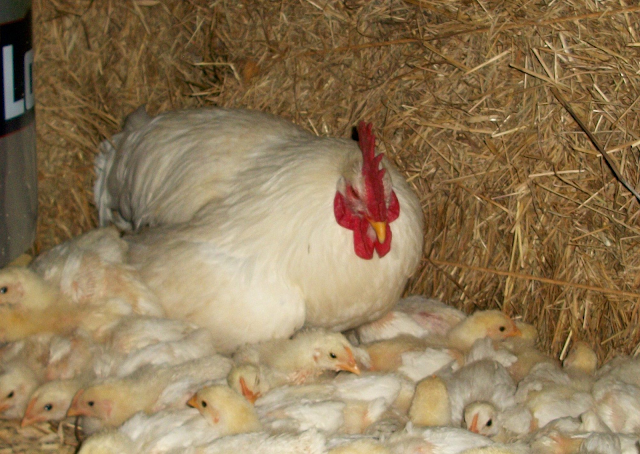
2. Artificial brooding
2. ARTIFICIAL BROODING
Artificial brooding is followed on a farm where a large number chickens are raised by artificial hatching. Here the rearing of young chickens is done without the aid of a hen. Successful brooding depends to a considerable extent upon providing the chickens with an adequate and steady source of heat. The heating unit is known as a brooder or foster mother. Brooder is a substitute for mother hen. Artificial brooding has the following advantages over the natural methods
(i) Large number of chicks may be brooded at a time.

(ii) Chicks may be reared at any time of the year.
(iii) No need of broody hen.
(iv) Sanitary condition may be controlled.
(v) Temperature may be regulated as required.
(vi) Feeding may be under‑taken according to plan.
(vii)‑ There is no possibility of spreading insects from mother hen to the chickens.
Day old chickens, can be reared very successfully by artificial method without additional heat being supplied to them. The brooder should have the following essentials
Dependable mechanism for controlling temperature and regular supply of fresh air, economic in construction, durable, adequate light and space; dryness, safety from fire, easy disinfection, and protection against chick enemies.
Brooders may be different kinds in accordance with the nature of sours from which the heat is supplied. Such as. 1Hover brooder, 2.Coal brooder, 3.Oil brooder, 4. Electric brooder, 5. Battery brooder
Out of these, electric brooder are very convenient and can be kept economically where the cost of electricity is low. Continuous and regular supply of electricity is essential for this brooder. The main disadvantage of this brooder is that the breakdown of current for a few hours during night may result in heavy losses by chilling. Kerosene lamp brooders are generally used when chickens are reared artificially on a small


