
Esterified Butyric Acid (Tributyrin)
A novel and proven technology to gradually deliver butyric acid along the GIT is known as “esterification”. Esterification is a chemical process allowing the binding of one glycerol molecule to 1, 2 or 3 organic acid molecules, forming mono-, di- or triglycerides of organic acids. Typical examples of esterified forms of butyric acid are monoglycerol butyrate, or monobutyrin, and triglycerol butyrate, or tributyrin. Both are extensively used in animal production. Tributyrin is a precursor of butyric acid that allows more molecules of butyric acid to be delivered into the small intestine directly because of the esterification technic. Thereby, the concentrations are two to three times higher than with conventional coated products. Esterification allows three butyric acid molecules to be bound to glycerol which can only be broken by endogenous pancreatic lipase.

Monobutyrin and tributyrin have the advantage compared to free butyric acid and its salts that
- Butter like fragnance,
- Non-corrosive,
- pH independent
- Gradually released throughout the entire gut by enzymatic activity of pancreatic lipases.
Worldwide scientific research and trials have confirmed the substantial benefits of butyric acid esterification, i.e. improved gut morphology, enhanced gut integrity, augmented nutrient digestion and absorption, and balanced immune system and luminal microbiota. Butyrate can increase cell proliferation in the small and large intestine, and enhance the intestinal barrier by facilitating tight junction assembly. These multifactorial benefits make mono- and tributyrins a globally accepted and widely used tool in managing optimal gut health.


Unrivaled butyric acid power ProPhorce™ SR ensures optimal performance, Good health and growth in poultry depends upon a good digestive system. The digestive system is like the engine of a vehicle. And similar to a finely-tuned engine, it needs proper care to ensure optimal performance. Choosing the right fuel Butyric acid is a key ingredient for optimal digestion. It’s like a high-performance fuel additive.
Butyric acid is the preferred energy source for colonocytes. However, it is absorbed by epithelial cells across the intestine providing approximately 70% of the energy generated from the short chain fatty acids for gut consumption. This is also well demonstrated in the study done in India where intestinal morphology (villi height, absorption surface area) was shown to be much better in ProPhorceTM SR 130 treated birds compared to control. The importance of butyric acid is not limited to its function as energy source, but also in terms of intestinal cell proliferation, differentiation and maturation, control of intestinal barrier function, pathogen control and inflammatory responses
Newly hatched chicks do not have high levels of lipase activity and fat digestibility is not matured until 1-2 weeks of age. Also with the intestinal flora not fully settled yet, digestive processes including the fat digestion will be relatively slow, but it is still there. Any type of fat that we give has to be “delivered” to the small amount of lipase that is available. It can be thought like hunting the lipase molecule, with more bullets. Pancreatic lipases tend to have a high preference for short-chain triglycerides, specifically the terminal fatty acids, so it is possible that the limited lipase in young birds is better able to release the butyrate from tributyrin compared to a fat-coated salt of butyrate, which consist of longer fat chains.
Lipopolysaccharide (LPS), a membrane glycolipid produced by gram-negative bacteria, can cause a strong immune response in animals and significant physiological changes.

Prophorce SR130 as an alternative to AGP’s
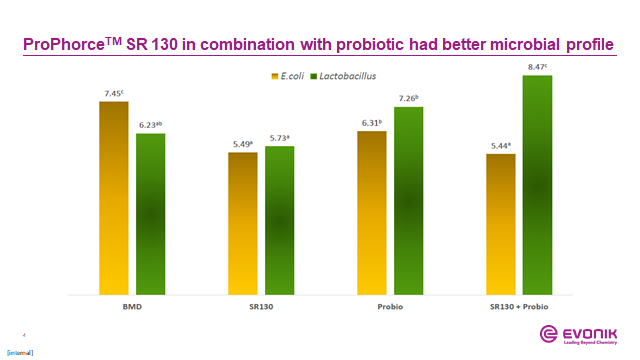
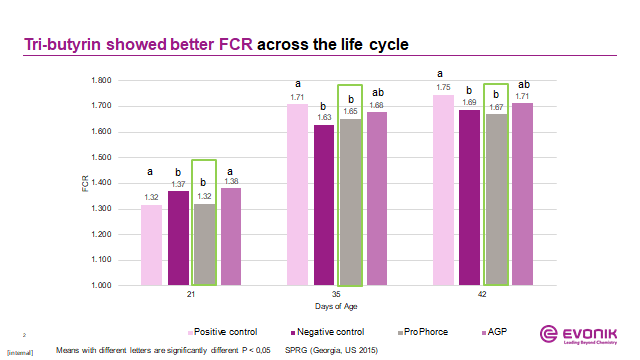
Tributyrin considered as an alternative to antibiotic growth promoter (AGPs) due to the fact that butyric acid can act as an energy source for animals, inhibit enteric pathogens, reduce the expression of pro-inflammatory cytokines, and promote gut health and development. However, it is difficult to use butyrate directly for animal production because it is volatile, corrosive, and quickly absorbed before arriving at the small intestine in addition to its offensive odor. Butyrins (including both mono-butyrate and tri-butyrate glycerides) have, therefore, been developed to overcome the drawbacks of butyrate in application. Butyrate can be released from tributyrin (TB) by the intestinal lipase, and then be absorbed by the small intestine.