
Feed cost is considered as a chief element of the poultry production cost accounting for up to 70% of total cost and remains the greatest constraint to poultry production. With the rise in feed ingredient prices, the cost of production also increases. However, an increase in the price for the conventional feed ingredients like maize and soybean meal is leading to high-cost production of broiler meat resulting in costly broiler meat. Maize is one of the widely used ingredients in broiler feed as it accounts for between 50-60% of most poultry feeds. Maize has a major contribution to energy in the feed but the fluctuations in price and feed-food competition results in higher prices. Moreover, the conventional feed resources for poultry production are mainly cereal-based which competes with human food.
Both energy and protein sources are especially limiting factors in poultry feed production. So the most appropriate solution to cope with the present feed cost issue is the utilization of non-conventional feed resources in broiler feed as these non-conventional feed resources could be the by-products coming from industries, fruits, and vegetable waste. The utilization of by-products to reduce the feed cost can be very helpful in cutting down the feed price and making it more affordable to the farmers.
Fruit waste can be used for this purpose. Fruit waste is procured from the damaged or culled fruits or the waste of fruit-producing in juice factories and commonly includes apple pomace, banana peel and leaves, citrus pulp and peels, mango peels, and seed kernels, etc. Considering mango, after citrus, as the most valuable fruit in terms of nutritional potential and production as well, its waste is as nutritious as its pulp. It is an important fruit crop that is grown mainly for the pulp and has high production from which a huge amount of waste is generated as well.
Pakistan has its mango production that stands at second rank after citrus and many important varieties of mango are being grown including Sindhri, Langra, Anwar Ratol, Chaunsa Black and White, etc. The by-products of mango include its leaves, peels, and seed kernel which can be used in animal feed as a source of starch or protein. Mango seed kernel is a major by-product of the mango fruit that is obtained by the utilization of pulp and reported as a good source of starch and carbohydrate. Mango seed constitutes about 20-60% of the fruit and the countries with its higher production have very little industrial use and therefore it is wasted and not properly managed.  Mango seed kernels have numerous nutritional aspects that can be utilized for good if their potential is completely explored. They were reported to contain polyphenols around 112mg per total of polyphenols per 100g of dry mango seed kernel powder.
It is estimated that mango processing yields between 150,000 and 400,000 tons of waste all over the world that may cause problems in the environment. It is estimated that after processing, 35-60% of the fruit is discarded; in the particular case of mango seeds, these are annually produced in more than a million tons as wastes and at present, these are not commercially utilized. A huge amount of waste generates after its processing in fruit industries, which causes pollution in the environment due to poor handling. The piles of fruit waste are left on empty grounds or being used at brick stations for burning purposes causing severe air pollution. This waste can serve as a great feed resource if properly handled and used in livestock feed and can be a way of bringing down the environmental concern. Because of its ample availability and little use as a by-product in many parts of the world, it is economically beneficial to investigate the use of mango seed kernel in poultry feeding.
Mango seed kernel can be considered to be a good replacement for grains like maize in poultry diets due to its nutritional profile that is capable to provide as much energy as maize can. In previous studies, it was reported that in the period of maize shortage, ground mango seed kernel may be used as an alternative in the broiler diet and can incorporate up to 20% in broiler chicken rations. Furthermore, another study concludes that it can be that 50-75% of maize can be replaced by mango seed kernel without imparting harmful effects in broiler chicken starter and finisher diets respectively. The use of mango seed kernels in poultry diets will not only solve the mango waste disposal problem but it will also help in reducing competition for grains between humans and poultry.


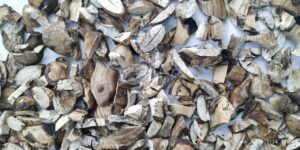
Prof. Dr. Zafar Hayat and his team conducted a research trial at College of Veterinary and Animal Sciences, Jhang to explore and evaluate the potential of raw mango seed kernel as a non-conventional feed resource in the broiler diet and to use it for the least cost formulation of feed. Mango seed kernel was used in the broiler diet as a replacement of maize grain at different levels. From the results of the study, it has been concluded that mango seed kernel as a replacement of maize added in the diet at 10% inclusion level showed comparable results in terms of growth performance and carcass characteristics without having any adverse effects on the performance of the birds. This substitution reduced the feed cost as well as the cost of broiler meat production. The facts about the composition of mango seed kernel and conclusion of the study favor its utilization as a feed ingredient as it is abundantly available and cheap as compared to maize as well as poor usage by human and certainly its production links with the critical period of demand and supply of grains make it ideal to further, evaluate its effects at different inclusion levels in the broiler diet.
So there is a need to educate and encourage farmers and feed mills to utilize such non-conventional feed resources which are not only capable to replace conventional costly ingredients but can also give almost similar results. Moreover, more experimental studies should be carried out to explore ways and means to develop procurement technologies as well as utilization of higher levels of MSK in poultry diets by adopting few reported methods to reduce tannin content present in mango seed kernel. Alongside, a feasible strategy should be developed to procure this valuable feedstuff in the production season of mango so that it can be utilized as a replacement during the time of grain scarcity.


