Cholesterol Metabolism
Cholesterol is a vital constituent of cell membranes and the precursor of steroid hormones and bile acids. It is clearly essential to life, yet its deposition in arteries has been associated with heart disease and artherosclerosis, two leading causes of death in humans. In a healthy organism, a balance should be maintained between the biosynthesis, utilization and transport of cholesterol, keeping its harmful deposition to a minimum.
FUNCTIONS
Cholesterol is the most abundant sterol found in the animal tissues. Most other steroids are derived from cholesterol. Cholesterol serves as the precursor for many important steroid hormones including 21-carbon steroids (Progesterone and most of the Adrenal Cortical hormones), the 19-carbon male sex hormone (Testosterone) and the 18-carbon Estrogens (Estradiol, Estrone and Estriol). It is an essential component of mammalian cell membranes where it regulates membrane fluidity. It is also a precursor of bile acids in liver.
METABOLISM AND EXCRETION OF CHOLESTEROL
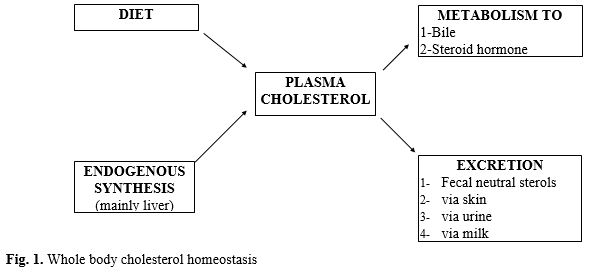
The various routes of cholesterol loss are given in the figure 1.


TRANSPORT OF CHOLESTEROL IN THE CIRCULATION
TRANSPORT PARTICLES
- Chylomicrons
- Very Low Density Lipoproteins (VLDL)
- Low Density Lipoproteins (LDL)
- High Density Lipoproteins (HDL)
SOME PROPERTIES OF THE MAJOR APOPROTEINS
Apolipoprotein | Major locations | Functions |
A-I | HDL | Cofactor for LCAT |
A-II | HDL | Structural |
B | CM, VLDL, LDL | Binding to cell receptor |
C-II | VLDL, LDL, HDL | Cofactor for lipoprotein lipase |
D | HDL | Cholesterol ester exchange protein |
E | VLDL, LDL, HDL | Binding to cell receptor; inhibitor of lipoprotein lipase |
TRANSPORT OF CHOLESTEROL
After absorption into enterocyte cholesterol from the diet is incorporated into a chylomicron. This particle is assembled in the golgi region and surrounded by a monomolecular film of phospholipid and apoproteins B. In the absence of apoprotein B, secretion into the lacteals does not occur. As lipoprotein lipase hydrolyses the triglyceride component to free fatty acid, the chylomicron particle becomes smaller. The chylomicron remnant is internalized for destruction by the lysosomes. The cholesterol ester is hydrolyzed to free sterol which can be excreted via the bile or incorporated into the VLDL.
BIOSYNTHESIS
Acetyl-CoA serves as the sole precursor, whereas liver is the major site of cholesterol synthesis but may be synthesized in intestine, skin, adrenal cortex and arterial wall. The enzymes involved are associated with microsomes, but some necessary CO-factors are in the cytoplasm.
The biosynthesis of cholesterol is regulated in part by the supply of cholesterol. High dietary level of cholesterol or the presence of cholesterol precursors result in depressed liver cholesterol synthesis.
The structure of a cholesterol molecule is given below.

All of the carbon atoms of cholesterol are derived from acetate. The major stages for cholesterol biosynthesis are:
Acetate –> Isoprenoid intermediate –>Squalene –>Cyclization product –>Cholesterol
The uptake of cholesterol from LDL, the major cholesterol-carrying lipoprotein in human plasma, occurs through 2 processes.
- A nonspecific, low-affinity process, bulk phase pinocytosis
- A specific, high-affinity process, adsorptive endocytosis
Binding of the LDL to its receptor via apo B component causes entrance of lipoprotein-receptor complex and is followed by fusion of the entered vesicle with lysosomes. Within the lysosome the apoprotein component of the LDL are hydrolysed to free amino acids while the cholesterol ester is hydrolysed to cholesterol and free fatty acid. The cholesterol is then incorporated in cellular membranes as free sterol. The LDL receptor probably recycles back to the plasma membrane. Since the cell is able to use this exogenous cholesterol for membrane synthesis. Excess cholesterol is stored in the cell as cholesterol ester in a reaction catalyzed by the acylcoenzyme A-cholesterol acyltransferase (ACAT) whose activity is activated by the LDL-cholesterol.
DISEASES OF HIGH CHOLESTEROL
GALLSTONES
Gallstone formation in the gallbladder and common bile duct is a common disease. The bile is the major excretory route for cholesterol and sterol. Increased biliary cholesterol secretion due to increased hepatic cholesterol synthesis, increased HMGR and decreased 7 a-hydroxylase activities have been found in the patients with cholesterol gallstones. Precipitation of cholesterol occurs particularly on concentration of bile in the gall bladder. Stones sometimes remain silent, they may obstruct the bile duct causing cholecystitis and produce fever and Jaundice.
ARTHEROSCLEROSIS
Artherosclerosis is the most common lethal disease. The major risk factors, hyperlipidaemia, hypertension and smoking are not related in a simple way. Artherosclerosis is a disease in which the arterial wall is thickened by the development of fibrous tissue and the accumulation of lipids. Mostly results from the lesions in the aorta and arteries supplying the heart, brain and lower limb.
Role of LDL Cholesterol in Artherogenesis
The receptor mediated route for binding and uptake of the LDL particle into cells, regulate the LDL cholesterol uptake. Accumulation of intracellular cholesterol shuts off entry by the receptor mediated process but does not affect entry by the receptor independent route.
The maximal contribution of the receptor mediated pathway, to the catabolism of LDL occurs at an LDL-cholesterol concentration of around 0.07 mmol, while the receptor independent process is allowing a greater input to occur. For maximal efficiency of LDL receptor function the plasma LDL cholesterol concentration should be around 0.07 mM. At the concentration of LDL cholesterol (around 3mM) LDL is taken up by the receptor independent route leading to an uncontrolled accumulation of cholesterol ester in excess of the cell’s need. The smooth muscle cells take on the appearance of the foam cells causes toxicity and cell death resulting in the lipid deposits and cell debris that comprise a large part of the fibrous plaque of artherosclerosis.
Treatment has concentrated on lowering the LDL cholesterol by the diet (low cholesterol, low saturated fat), and by the drugs such as bile acid sequestrant cholestyramine. In addition, factors associated with raised HDL cholesterol such as regular vigorous physical activity and a lean physique are recommended for those at risk.


